The Whimsical World of the Wiltshire Snare
Introduction: Fact, Folklore or Fiction?
The Wiltshire Snare is a creature of wonder. Beautiful, shy and migratory, they are unique to Wiltshire and spend their lives in small family groups, called Clans.
They are rarely seen nowadays, elusive and private creatures, there has been very little study of their habitat, anatomy or behaviour.
The single definitive study that exists today was carried out by amateur biologist, Olivia Emily Moses (known as Emily), in the 1880s. Her documents on the Wiltshire Snare surfaced at the end of the First World War, and again more recently. Her diaries and annotated sketchbooks are the main bank of knowledge of this strange and delicate creature.
Many have questioned if the Wiltshire Snare is real, or are simply creatures of folklore, or even a fictional animal made up as a story by Emily Moses to amuse a young great niece in the Edwardian period. Some may even question the existence of Olivia Emily Moses herself.
Anatomy
The anatomy of a Wiltshire Snare, hereafter, the Snare, is very different from most other animals. A Snare is defined by the presence of the spiral shell and the foot, which people will recognise as belonging to the snail family, and the neck, head and ears of an European brown hare. Making it unique to the animal kingdom. Their body is a cluster of peculiarities and surprising characteristics not found in other animals.
The male Snare, according to Emily Moses records, is turquoise, whilst the females shells have sage greens tones, the young are born with turquoise shells, with the colour changing at the age of around one year to that of the adult.
The foot contains glands that secrete a slippery mucus which reduces the friction to facilitate the Snare’s movement, enabling it to move smoothly or “glide” over surfaces. This mucus can be seen in the “trace” that Snares leaves on surfaces as it moves, however, unlike the snail family the trail of a Snare is glittery; making it easy to see if you are lucky enough to have a Clan in your own garden. Whether this secretion helps deter predators, as in snails, has not been studied.
Snarlings
The Snare lays eggs, which hatch in around eight days, giving rise to tiny, very cute, Snarlings. As young Snarlings they are able to retract into their shell, a characteristic that disappears around one year of age. Emily Moses wrote that Snares live until around six years, becoming mature at around two years. This suggests that she studied them over a long period of time.
You can find a short video of a Sage and her young on Instagram.
Communication
The Snare communicates with a high pitched song that is strange and beautiful. It is filled with melancholy, and can be mistaken for a wailing of winds over an open heathland. In their small Clans they more commonly communicate through ear movement and whisker quivering, saving their songs for the four migration periods of the year when the individual Clans gather together at the ancient stone monuments of Wiltshire.
Habitat
The Snares live in their small Clans, normally an extended family of around 20 individuals of varying ages. The leader is, according to Emily, known as the Sage, and is generally female, but can be male. They do not hibernate, but do slow down over the winter months. Their common habitat is a secluded garden, and they can often be found in hidden ivy filled corners. They are shy, reclusive creatures; if you see a glittery trail in your garden you may be privileged to have a Clan in residence. Treat them with respect; if you want to see them it is best to sit quietly at dawn or dusk, as they are crepuscular, and leave small offerings of sage leaves on the ground in front of you.
A short video clip of a recent Snare sighting can be seen on Instagram.
A short video of a Snare eating can be seen on Instagram.
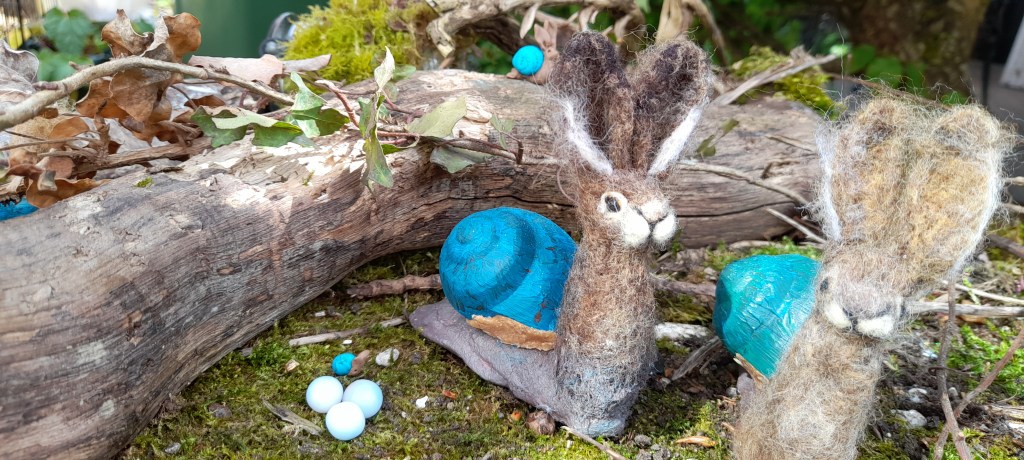
 The Wiltshire snare